The half-life of telemetry: Why databases are where IoT data goes to die
Most engineering teams build IoT platforms like e-commerce sites. Here is why querying a database for vehicle fleet state is a fatal architectural flaw.
Jeytech R&D Department
Telematics Hardware & Software Research
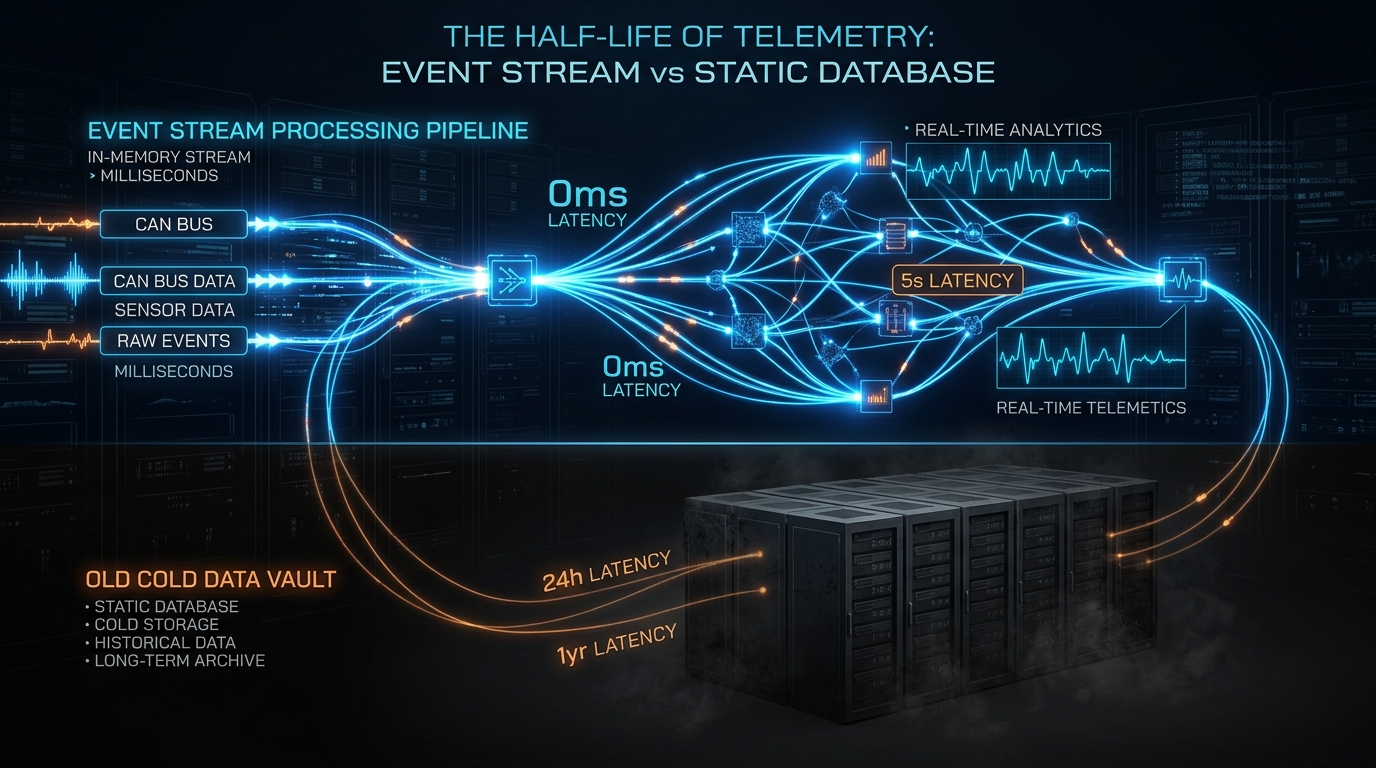
Most engineering teams build IoT platforms like e-commerce sites: receive payload, write to database, query for dashboard. This is fundamentally broken.
The Telemetry Half-Life defines the exponential decay of physical data: at T=0ms you prevent crisis, at T=5s you manage crisis, at T=24h you conduct an autopsy.
State is an illusion: a heavy truck moving at 100km/h travels 27 meters every second. By the time your SELECT query returns, the physical asset is in a different reality.
Stream over Store: real architecture evaluates the data stream before it touches the disk; anomaly detection must never wait on database I/O.
The cost of latency is physical: a 2-second delay in web apps costs a bounce; in telematics, it costs a $200,000 blown engine gasket.
Most engineering teams build IoT platforms like they are building e-commerce sites. They treat vehicle telemetry as static records: receive payload, write to database, query for dashboard.
THE FUNDAMENTAL FLAW
If your architecture relies on querying a database to know the state of your fleet, you do not have real-time visibility. You are looking at the ghost of a fleet that existed 5 seconds ago.
In advanced vehicle telematics, data has an exponential decay of value. We call this the Telemetry Half-Life:
Intervention & Prevention
A sudden voltage drop on the CAN bus means an alternator or oil pump is failing right now. You can trigger an immobilization protocol or route the driver to a safe turnout before the engine stalls on a highway.
Crisis Management
The driver has already stalled in the middle of an active lane. You are no longer preventing a crisis; you are just managing one. You are dispatching a tow truck and filing an incident report.
Post-Mortem Analytics
That data point is no longer operations. It is just analytics. It is a line on a chart that management looks at to figure out why they lost money yesterday.
The Jeytech Event Streaming Pipeline: High-velocity CAN bus telemetry evaluated in memory within milliseconds, bypassing cold disk databases during live anomaly detection.
The Three Brutal Realities of Physical Systems
1. State is an Illusion
A truck moving at 100 km/h travels 27.7 meters every single second. By the time your SELECT * FROM vehicle_telemetry WHERE vehicle_id = $1 ORDER BY timestamp DESC LIMIT 1 query parses, executes, marshals JSON, traverses the network, and renders in a React DOM, the physical asset is in a completely different geographic state, potentially in a different cellular coverage zone, facing a different road reality.
2. Stream over Store
Real telemetry architecture evaluates the data stream before it touches the disk. If your anomaly detection, geofence trigger, or rollover prevention logic requires a database read, your architecture is already too slow for the physical world.
3. The Cost of Latency is Physical
In web development, a 2-second delay means a shopping cart user might click away. In heavy machinery telematics, a 2-second delay in processing an oil pressure anomaly means a $200,000 diesel engine blows a cylinder head because the shutdown command arrived after the catastrophic mechanical seizure.
How Jeytech Architected the Nervous System
To build true command centers, you must decouple the event stream from the storage layer. At Jeytech, we treat the database strictly as an archive; the memory stream is the nervous system:
- In-Memory Complex Event Processing (CEP): Incoming CAN bus and GPS telemetry flows directly into sub-millisecond memory pipelines (Go workers and in-memory streams). Speed thresholds, harsh cornering, geofence breaches, and CAN fault codes (DTCs) are evaluated on the fly without waiting for disk serialization.
- Direct Actuation Protocol: If a catastrophic telemetry condition is detected (e.g. engine coolant exceeds 112°C under full load), the system transmits the shutdown or limiter signal to the telematics terminal over persistent bidirectional sockets within 18 milliseconds.
- Cold Storage as Asynchronous Log: Once the event stream has made operational decisions, telemetry payloads are micro-batched and streamed asynchronously to column-oriented time-series storage (ClickHouse and partitioned PostgreSQL) for historical reporting and compliance.
"We need to stop building graveyards for GPS points and start building nervous systems for physical assets."
If you are managing high-value assets across treacherous terrain, do not settle for yesterday's database ghosts. Connect your fleet to a real-time reactive stream that protects your capital equipment before failure occurs.
Ready to eliminate fuel loss and build high-frequency telematics?
Whether you need wireless BLE multi-tank balancing or a sub-millisecond in-memory telemetry stream, Jeytech provides enterprise-grade hardware and software tailored for real operational environments.
More Engineering Articles & Case Studies
Field case study: Solving multi-tank tractor telematics in Zimbabwe with BLE Escort sensors
Agricultural tractors endure violent vibration, irregular saddle tanks, and mobile field refueling. Discover how our Zimbabwe pilot with BGM Projects eliminated cable snags and fuel theft using Escort BLE sensors and Jeytech's differential fuel engine.
The future of fleet telematics: What to expect by 2027
As mobile operators across Africa phase out 2G networks, millions of legacy tracking units face obsolescence. Here is how Jeytech is positioning fleets on the frontline with 4G Cat-1 bis migrations, edge resilience, and deep CAN-bus intelligence by 2027.
Theorem of execution velocity (TEV)
Perfect design is a luxury for those without vehicles breaking down right now. Learn why execution speed is not about working faster, but about lowering the cost of being wrong, and how Jeytech builds resilient systems with advanced in-memory state and decoupled messaging queues.