The future of fleet telematics: What to expect by 2027
Building for African markets, navigating the looming 2G sunset, and moving from passive GPS tracking to active edge intelligence.
Jeytech R&D Department
Telematics Hardware & Software Research
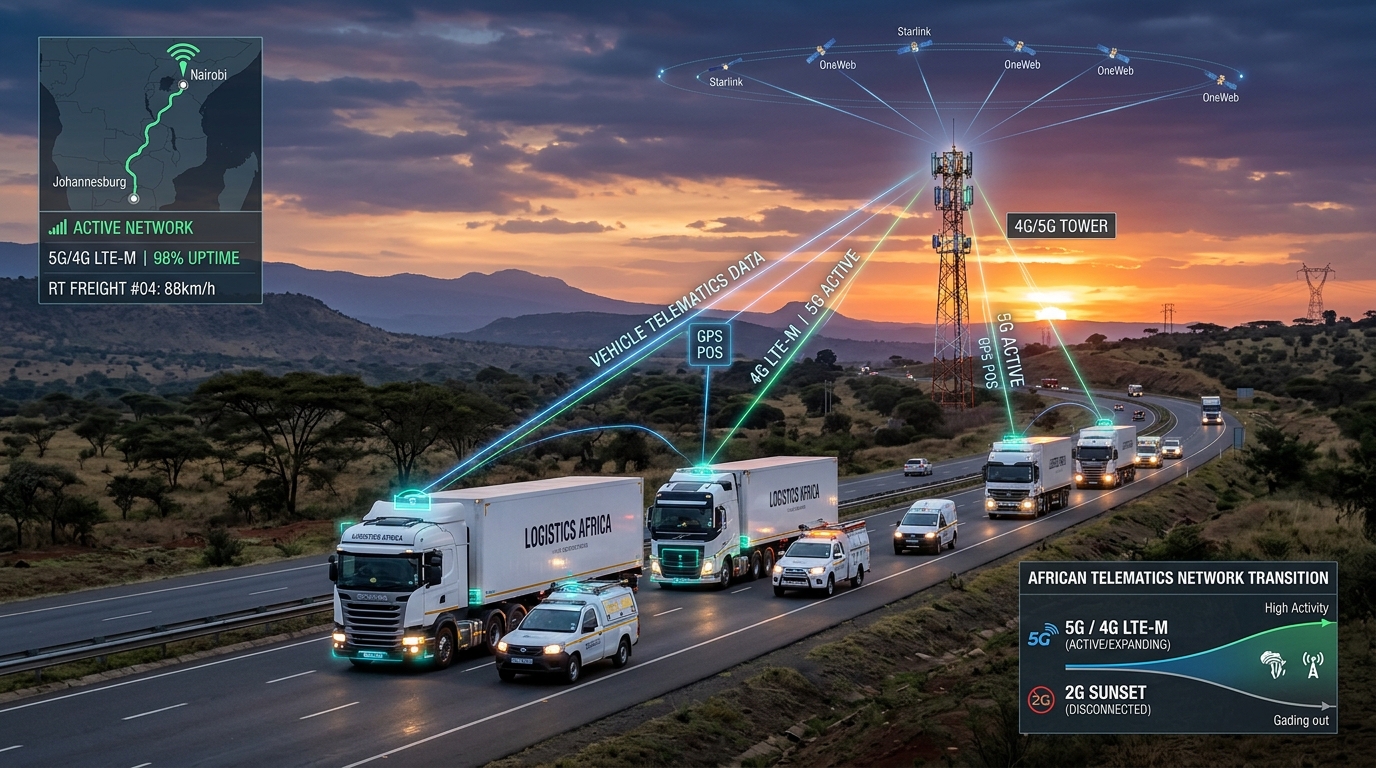
Major African mobile carriers (Safaricom, MTN, Econet, Airtel) are rapidly decommissioning 2G spectrum to free frequencies for 4G and 5G.
Over 75% of commercial telematics units currently installed across East and Southern Africa rely on 2G GPRS modules that will go dark by 2027.
4G LTE Cat-1 bis has emerged as the definitive hardware standard for Africa, offering 4G speeds and longevity at the component cost of legacy 2G chips.
Remote corridor resilience: fleets traversing northern Kenya or southern Zimbabwe require intelligent edge buffering that stores up to 100,000 events offline.
By 2027, basic GPS breadcrumbs will be commoditized; fleet value will derive entirely from deep CAN/J1939 engine telemetry, multi-tank fuel balance, and predictive maintenance.
The telematics industry is standing on the precipice of its most significant tectonic shift in two decades. Between now and 2027, the intersection of mobile network decommissioning, African continental trade corridors, and edge computing will render traditional GPS tracking obsolete.
Modern freight fleets traversing East and Southern African transit corridors over high-speed 4G LTE-M and Cat-1 cellular networks.
1. The Looming 2G Sunset: The African Telematics Cliff
For over fifteen years, the African telematics industry ran almost exclusively on cheap 2G GPRS (General Packet Radio Service) modems. 2G was cheap, penetrated long distances across rural savannahs, and consumed negligible bandwidth.
That era is officially ending. Major telecom operators across the continent—including Safaricom in Kenya, MTN in South Africa and Nigeria, Econet in Zimbabwe, and Airtel across Central Africa—are actively refarming their 900MHz and 1800MHz spectrum bands to support high-density 4G LTE and 5G mobile broadband.
The Real-World Impact on Fleets
2. Leading the 2G-to-4G Hardware Transition
Jeytech focuses exclusively on telematics adoption and building for changing technologies. We do not operate network nodes or cellular infrastructure. Instead, we support fleet operators navigating hardware obsolescence by integrating with industry-standard telematics hardware from top manufacturers, majorly using Teltonika products. As the African market transitions, we heavily deploy and integrate the Teltonika FMC series, FMB, M1, and CAT1 devices to harness modern LTE Cat-1 bis technology. Unlike standard 4G Cat-4 (which requires dual antennas and expensive silicon designed for video streaming), Cat-1 bis uses a single antenna design with low power consumption and hardware costs comparable to legacy 2G modules.
- Multi-Network Roaming (eSIM / Multi-IMSI): Jeytech terminals automatically negotiate between Tier-1 national carriers, ensuring that a truck crossing from Kenya into Uganda or Zimbabwe into Mozambique switches carrier profiles seamlessly without packet drops.
- Full Backward Compatibility: While 2G towers remain operational in secondary zones, our modems maintain 2G fallback capability, ensuring 100% coverage continuity during the multi-year transition window.
- High-Bandwidth CAN Streaming: With 4G Cat-1's 10 Mbps downlink and 5 Mbps uplink speeds, fleets can stream full-rate high-frequency CAN bus telemetry that was simply impossible over 40 kbps 2G GPRS channels.
3. Building for African Operating Realities
Silicon Valley fleet software assumes smooth highways, ubiquitous 5G coverage, and clean electricity. African commercial reality is different: extreme dust, 45°C ambient temperatures, vibration, variable fuel sulfur quality, and 48-volt jump-starts that fry generic hardware.
100,000-Point Edge Flash Buffering
When trucks traverse remote border deserts where no cell signal exists for hours, Jeytech devices buffer every GPS coordinate, CAN parameter, and fuel reading into non-volatile industrial flash memory. Upon reaching a cellular tower, the device transmits compressed deltas without overwhelming server ingestion.
Extreme Electrical Hardening
Commercial trucks often endure severe electrical transients, including 100V load-dump surges when mechanics jump-start heavy diesel engines. Jeytech hardware incorporates automotive-grade TVS surge suppressors and wide 9V–36V inputs designed for brutal duty cycles.
4. Beyond 2027: The Autonomous Command Center
By 2027, the concept of a dispatcher staring at GPS dots on a map will be seen as quaint. The future belongs to Autonomous Command Centers:
- Predictive Component Lifetime: Evaluating continuous vibration curves and transmission oil temperatures to schedule repairs days before a breakdown halts a supply chain.
- Edge Geofencing Actuation: Geofence evaluation running directly inside the vehicle's onboard terminal. If a truck enters an unapproved high-risk zone or deviates from a licensed corridor, the vehicle speed governor activates autonomously, even if completely offline from the cloud.
- Unified Multi-Energy Dashboards: Managing mixed fleets of diesel haulers, electric light commercial vehicles (e-LCVs), and dual-tank agricultural tractors in one unified pane of glass.
Position Your Fleet on the Frontline
The transition toward 2027 is not an upgrade cycle you can ignore. Fleets that modernize their telematics stack today will enjoy superior fuel security, lower insurance premiums, and total uptime across African corridors.
At Jeytech, we are building that future right now. Explore our modern telematics platform at mobility.jeytech.net or integrate your existing enterprise ERP with our developer APIs at api.jeytech.net.
Ready to eliminate fuel loss and build high-frequency telematics?
Whether you need wireless BLE multi-tank balancing or a sub-millisecond in-memory telemetry stream, Jeytech provides enterprise-grade hardware and software tailored for real operational environments.
More Engineering Articles & Case Studies
Field case study: Solving multi-tank tractor telematics in Zimbabwe with BLE Escort sensors
Agricultural tractors endure violent vibration, irregular saddle tanks, and mobile field refueling. Discover how our Zimbabwe pilot with BGM Projects eliminated cable snags and fuel theft using Escort BLE sensors and Jeytech's differential fuel engine.
The half-life of telemetry: Why databases are where IoT data goes to die
Data in physical systems has an exponential decay of value. At T=0ms an alert prevents a $200k engine failure; at T=5s the truck has stalled; at T=24h it's just an autopsy chart. Discover why decoupling the memory event stream from disk storage is the only way to build true command centers.
Theorem of execution velocity (TEV)
Perfect design is a luxury for those without vehicles breaking down right now. Learn why execution speed is not about working faster, but about lowering the cost of being wrong, and how Jeytech builds resilient systems with advanced in-memory state and decoupled messaging queues.